
Key Takeaways:
Traditional lectures remain an efficient way to deliver foundational health science content, but they often rely on passive learning. Flipped classrooms shift content review outside of class, allowing students to engage in active learning, problem-solving, and clinical reasoning during instructional time. Many health education programs achieve the best outcomes by combining both approaches to support knowledge retention, engagement, and workforce readiness.
For centuries, lectures have been the foundation of higher education. In health science programs especially, the lecture model has provided an efficient way to deliver large volumes of complex information to students. However, as healthcare education evolves to meet the demands of modern practice, many institutions are reevaluating traditional teaching methods and exploring alternatives such as the flipped classroom.
While both approaches have value, understanding their strengths, limitations, and impact on student outcomes is essential for university leaders seeking to design effective health education programs.
The Traditional Lecture Model
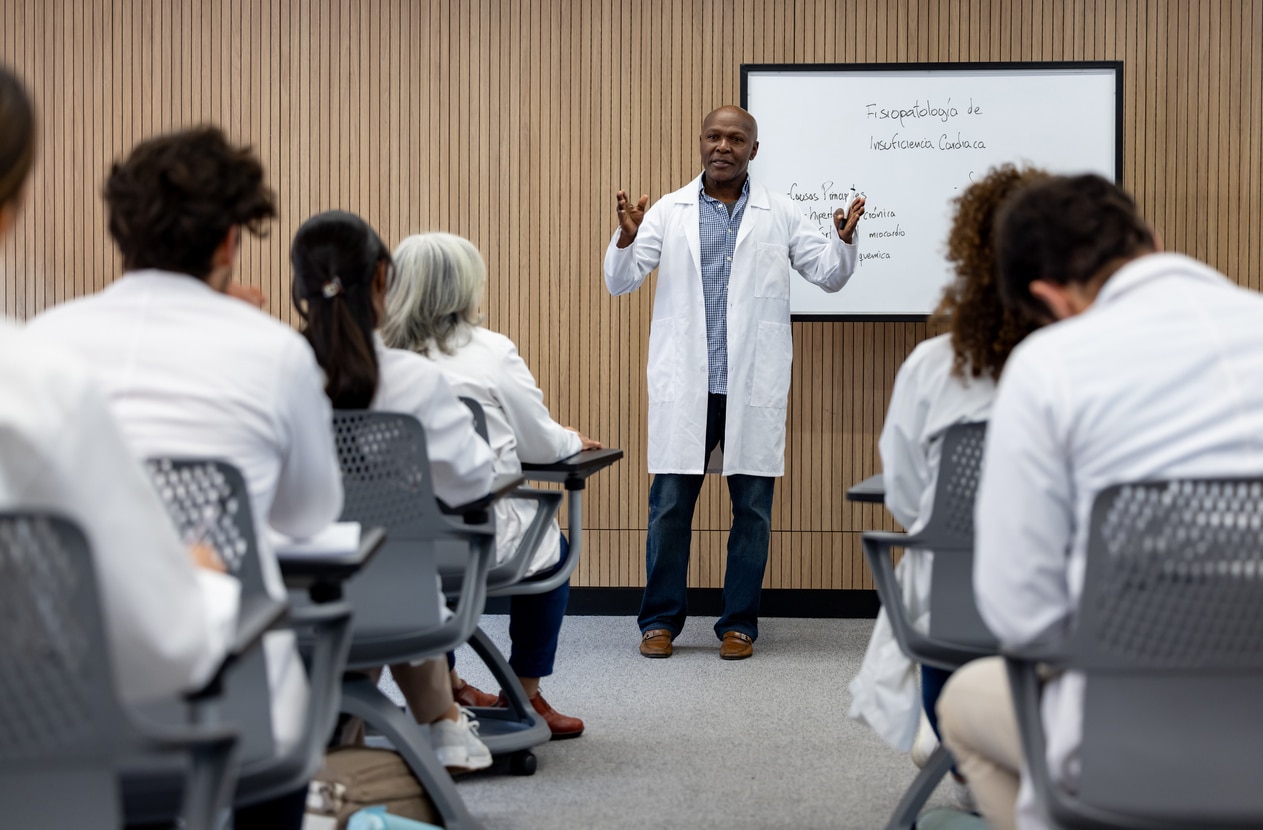
The traditional lecture places the instructor at the center of the learning experience. Faculty members present information during class sessions, and students are responsible for absorbing, organizing, and reviewing the material afterward.
This model offers several advantages:
- Scalability: Large groups of students can be taught simultaneously.
- Efficiency: Faculty can cover significant amounts of content in a structured manner.
- Consistency: All learners receive the same information and instruction.
In disciplines such as anatomy, physiology, and biochemistry, lectures can provide a useful framework for introducing foundational concepts.
However, lectures also present challenges. Research in educational psychology has consistently shown that passive learning often results in lower retention rates compared to active learning strategies. Students may struggle to maintain attention during extended lectures, and opportunities for real-time application of knowledge are often limited.
For health professions education, where critical thinking and clinical reasoning are essential, passive information transfer may not always translate into long-term competency.
What Is the Flipped Classroom?
The flipped classroom reverses the traditional instructional model. Instead of receiving content for the first time during class, students review foundational materials before attending class. These materials may include recorded lectures, readings, videos, or interactive modules.
Classroom time is then devoted to activities such as:
- Case-based discussions
- Problem-solving exercises
- Team-based learning
- Clinical simulations
- Faculty-guided application of concepts
Rather than serving primarily as content deliverers, instructors become facilitators who guide students through higher-order learning activities. This approach aligns with educational frameworks such as Bloom’s Taxonomy of Learning, which encourages students to move beyond memorization and toward analysis, evaluation, and application.
Comparing Student Outcomes
One of the most significant questions for administrators is whether the flipped classroom actually improves outcomes. Studies across health professions education—including medicine, nursing, pharmacy, and physician assistant programs—suggest several benefits:
Increased Engagement
Students in flipped environments typically spend more time actively participating in discussions and collaborative exercises. Rather than listening passively, they are required to apply concepts and defend their reasoning. This engagement can lead to deeper understanding and stronger knowledge retention.
Improved Critical Thinking
Healthcare professionals must make decisions in complex, uncertain situations. The flipped classroom creates opportunities for students to practice clinical reasoning before entering real-world settings.
Case-based activities mirror the decision-making processes students will encounter in patient care, helping bridge the gap between theory and practice.
Better Preparation for Clinical Education
Clinical rotations demand more than factual knowledge. Students must synthesize information, communicate effectively, and solve problems in real time.
Because flipped classrooms emphasize application and discussion, students often develop skills that translate more directly to clinical environments.
Academic Performance
While results vary across programs, many institutions report equal or improved examination performance among students participating in flipped classroom models. Importantly, gains are often most noticeable in assessments that measure application and reasoning rather than simple recall.
Challenges of Implementation
Despite its advantages, the flipped classroom is not a universal solution. Successful implementation requires significant planning and institutional support.
Faculty Development
Transitioning from lectures to active learning demands a different instructional skill set. Faculty may need training in facilitation techniques, assessment design, and educational technology. Without proper support, instructors can struggle to create meaningful classroom experiences.
Student Accountability
The flipped model depends on students completing pre-class assignments. If learners arrive unprepared, classroom discussions and activities become less effective. Programs must establish clear expectations and accountability measures to ensure participation.
Resource Requirements
Developing high-quality pre-class content often requires upfront investment. Video production, instructional design support, and learning management systems may be necessary to create an engaging experience.
However, many institutions find that these investments yield long-term benefits through improved student outcomes and more efficient use of faculty expertise.
Finding the Right Balance
For many health education programs, the debate is not simply lectures versus flipped classrooms. Instead, the most effective strategy often combines elements of both.
Foundational lectures can still play an important role when introducing difficult concepts or providing expert perspectives. At the same time, active learning experiences can reinforce and extend that knowledge through application. A hybrid approach allows institutions to leverage the strengths of each model while minimizing their respective limitations.
The key question for administrators is not which format is inherently better, but which instructional methods best support student success, program goals, and workforce readiness. As healthcare continues to evolve, educational models must evolve as well. Students entering medicine and related professions need more than content knowledge; they need critical thinking skills, adaptability, and the ability to apply learning in complex clinical settings.
Preparing Future Healthcare Professionals with Tiber Health Innovation
At Tiber Health Innovation, educational innovation is central to preparing students for success in medical and health professions pathways. The Master of Science in Medical Science (MSMS) curriculum incorporates evidence-based educational strategies designed to strengthen foundational science knowledge while developing the critical thinking and problem-solving skills required in modern healthcare.
By combining rigorous academic preparation with engaging, student-centered learning experiences, THI’s MSMS program helps students build the competencies needed for success in medical school and beyond. For universities seeking scalable, outcomes-focused solutions in health education, Tiber Health Innovation offers a curriculum designed to meet the demands of today’s learners and tomorrow’s healthcare workforce. If you’re interested in seeing how this works for yourself, you can schedule a demo today.
Additional Reading and Links:
- The Flipped Classroom in Medical Education: A New Standard in Teaching (Phillips and Weisbauer) – Trends in Anesthesiology and Critical Care
- How Flipped Classrooms can Transform Medical Education – Tiber Health Innovation